The course is designed to:
- Build a strong foundation in Python programming from the beginner level.
- Develop practical skills in NumPy, Pandas, data manipulation, and data cleaning.
- Teach learners how to perform Exploratory Data Analysis (EDA) and communicate insights through data visualization.
- Develop practical knowledge of classical Machine Learning using Scikit-Learn.
- Teach regression, classification, tree-based models, clustering, model evaluation, and model tuning.
- Introduce Generative AI and AI-powered coding assistants for faster data analysis and model development.
- Enable learners to work with APIs, JSON data, LLMs, and AI-assisted workflows.
- Provide hands-on experience through an end-to-end capstone project.
- Help learners build a professional GitHub portfolio, optimize their resume, and prepare for interviews.
Course Description
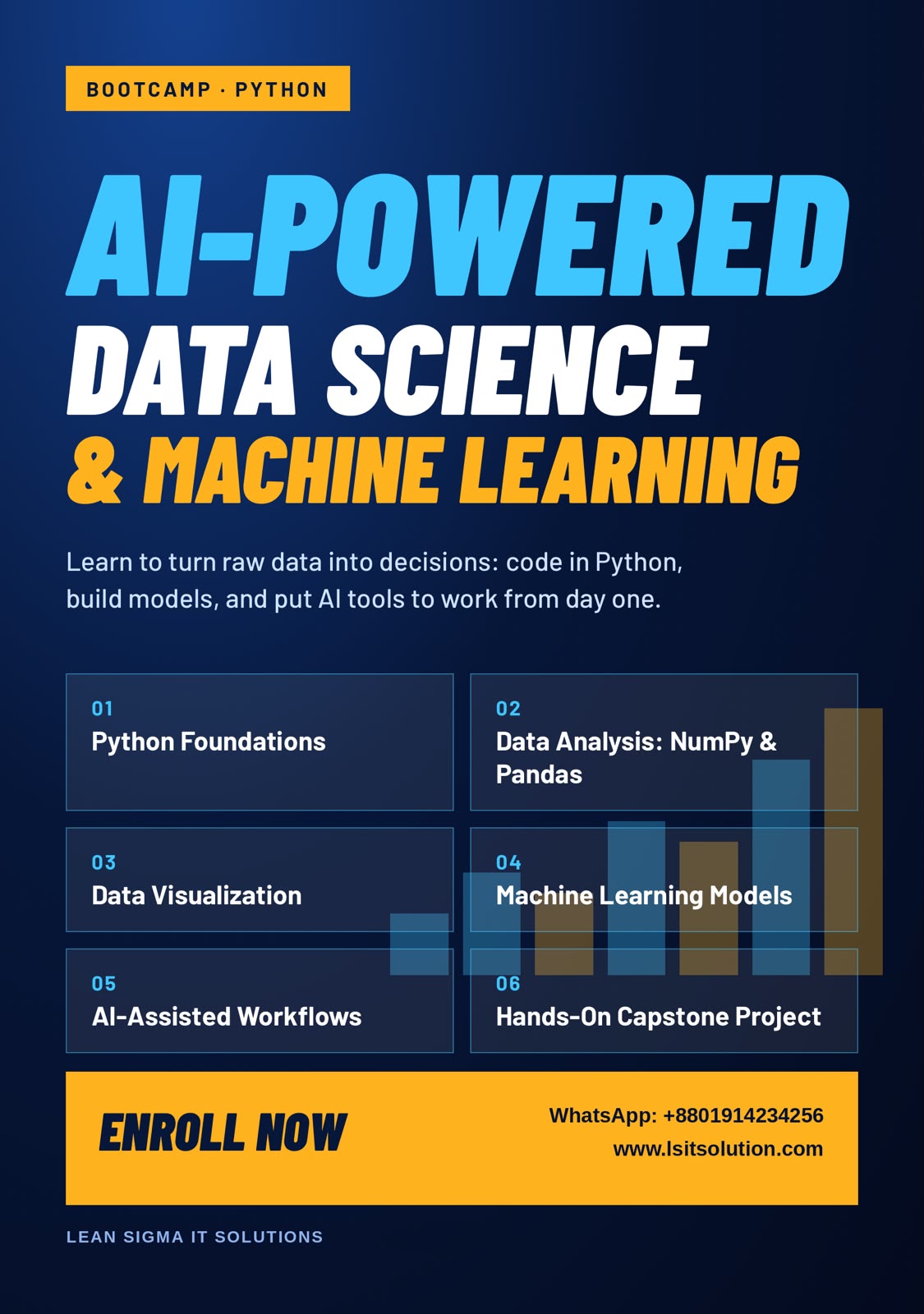
The Complete AI-Powered Data Science & Machine Learning Bootcamp (Python) is a comprehensive, hands-on program designed to take learners from foundational Python programming to practical Data Science, Machine Learning, and AI-powered workflows.
The course combines traditional Data Science skills with modern Generative AI tools and workflows. Learners progressively develop the ability to write Python code, manipulate and clean real-world datasets, perform exploratory analysis, create visualizations, build and evaluate Machine Learning models, and integrate AI tools into their daily workflow.
The program consists of 25 classes across five modules, beginning with Python Foundations and progressing through Data Manipulation and EDA, Classical Machine Learning, AI-Powered Workflows and Generative AI, and finally an end-to-end Capstone Project and Career Launch module.
No previous programming or Data Science experience is required. The course is designed for beginners as well as professionals, analysts, developers, and others looking to build practical Python, AI, and Data Science capabilities.
Course Outline Details
Module 1: Python Foundations & AI Coding Assistants
Classes 1–5
Class 1: Welcome & Environment Setup
- Jupyter Notebook
- Google Colab
- Environment configuration
- AI coding assistants
Class 2: Python Basics
- Variables
- Primitive data types
- Arithmetic operators
- Logical operators
Class 3: Control Flow
- Conditional statements
- If-Else
- For loops
- While loops
Class 4: Python Data Structures
- Lists
- Tuples
- Dictionaries
- Sets
Class 5: Functions & Error Handling
- Functions
- Modular programming
- Lambda expressions
- Try-Except
- Error handling
Module 2: Data Manipulation & Exploratory Data Analysis
Classes 6–10
Class 6: Numerical Computing with NumPy
- Vectors
- Multidimensional arrays
- Mathematical operations
- Matrix operations
Class 7: Tabular Manipulation with Pandas
- Series
- DataFrames
- Data inspection
- Indexing
Class 8: Data Cleaning & Preprocessing
- Missing values
- Outlier detection
- Duplicate records
- Data type conversion
Class 9: Exploratory Data Analysis
- Data aggregation
- GroupBy operations
- Filtering
- Statistical summaries
Class 10: Data Visualization Mastery
- Data storytelling
- Matplotlib
- Seaborn
- Visualization techniques
Module 3: Classical Machine Learning with Scikit-Learn
Classes 11–18
Class 11: Introduction to Machine Learning
- Machine Learning fundamentals
- Supervised learning
- Unsupervised learning
- Standard ML workflows
Class 12: Data Splitting & Feature Scaling
- Train-test split
- Normalization
- Standardization
Class 13: Regression Models
- Simple Linear Regression
- Multiple Linear Regression
- Continuous-value prediction
Class 14: Classification Models
- Logistic Regression
- Binary classification
Class 15: Model Evaluation Metrics
- Accuracy
- Precision
- Recall
- F1-Score
- ROC-AUC
Class 16: Tree-Based Models
- Decision Trees
- Random Forest
- Ensemble models
Class 17: Unsupervised Learning
- K-Means Clustering
- Customer segmentation
Class 18: Model Tuning & Pipelines
- Hyperparameter optimization
- Grid Search
- Machine Learning pipelines
Module 4: AI-Powered Workflows & Generative AI Integration
Classes 19–22
Class 19: Prompt Engineering for Data Scientists
- Effective AI prompting
- AI-assisted coding
- Code generation
- Code refactoring
- Code documentation
Class 20: Automated Data Analysis & Copilots
- PandasAI
- Natural-language data queries
- AI-assisted data analysis
Class 21: Working with APIs
- REST APIs
- Live web data
- JSON structures
- API-based workflows
Class 22: Introduction to LLMs
- Large Language Models
- LLM fundamentals
- Hugging Face ecosystem basics
Module 5: Capstone Project & Career Launch
Classes 23–25
Class 23: Capstone Project – Part 1
- Problem definition
- Data gathering
- Exploratory Data Analysis
- Data cleaning
Class 24: Capstone Project – Part 2
- Model training
- Model evaluation
- Validation
- AI-driven performance optimization
Class 25: Portfolio & Career Launch
- GitHub repository best practices
- Portfolio development
- Resume optimization
- Interview preparation
Course Outcomes
After successfully completing the course, participants will be able to:
- Write and understand Python programs using fundamental programming concepts, data structures, functions, and error handling.
- Work with data using NumPy and Pandas, including data inspection, manipulation, cleaning, and preprocessing.
- Perform Exploratory Data Analysis (EDA) using aggregation, filtering, statistical summaries, and visualization techniques.
- Create meaningful data visualizations and stories using Matplotlib and Seaborn.
- Understand and apply Machine Learning workflows using Scikit-Learn.
- Build regression and classification models for practical predictive tasks.
- Apply Decision Trees, Random Forests, and K-Means Clustering to appropriate Machine Learning problems.
- Evaluate Machine Learning models using Accuracy, Precision, Recall, F1-Score, and ROC-AUC.
- Improve Machine Learning models through feature scaling, hyperparameter optimization, Grid Search, and pipelines.
- Use Generative AI and AI coding assistants to generate, refactor, document, and improve code and data-analysis workflows.
- Work with APIs, JSON data, and LLM technologies as part of modern AI-powered Data Science workflows.
- Complete an end-to-end Data Science project, from problem definition and data gathering through analysis, modeling, evaluation, and optimization.
- Build a professional Data Science portfolio using GitHub and prepare a resume and interview strategy for career opportunities.
Overall Intended Outcome
The intended outcome is to move learners from beginner-level programming knowledge toward practical, job-ready Data Science, Machine Learning, and AI-powered workflow capabilities.