

Synchronizing Systems
Please wait while we initialize your environment
Please wait while we initialize your environment
Prepare for the premier cyber security certification. Master the eight CISSP domains to design, implement, and manage best-in-class information security programs.
Created By
LSIT Global Faculty
Last Updated
April 2026
Language
English / Bengali
Course Objectives:
The CISSP training course is designed to:
• Provide comprehensive knowledge of information security principles and best practices.
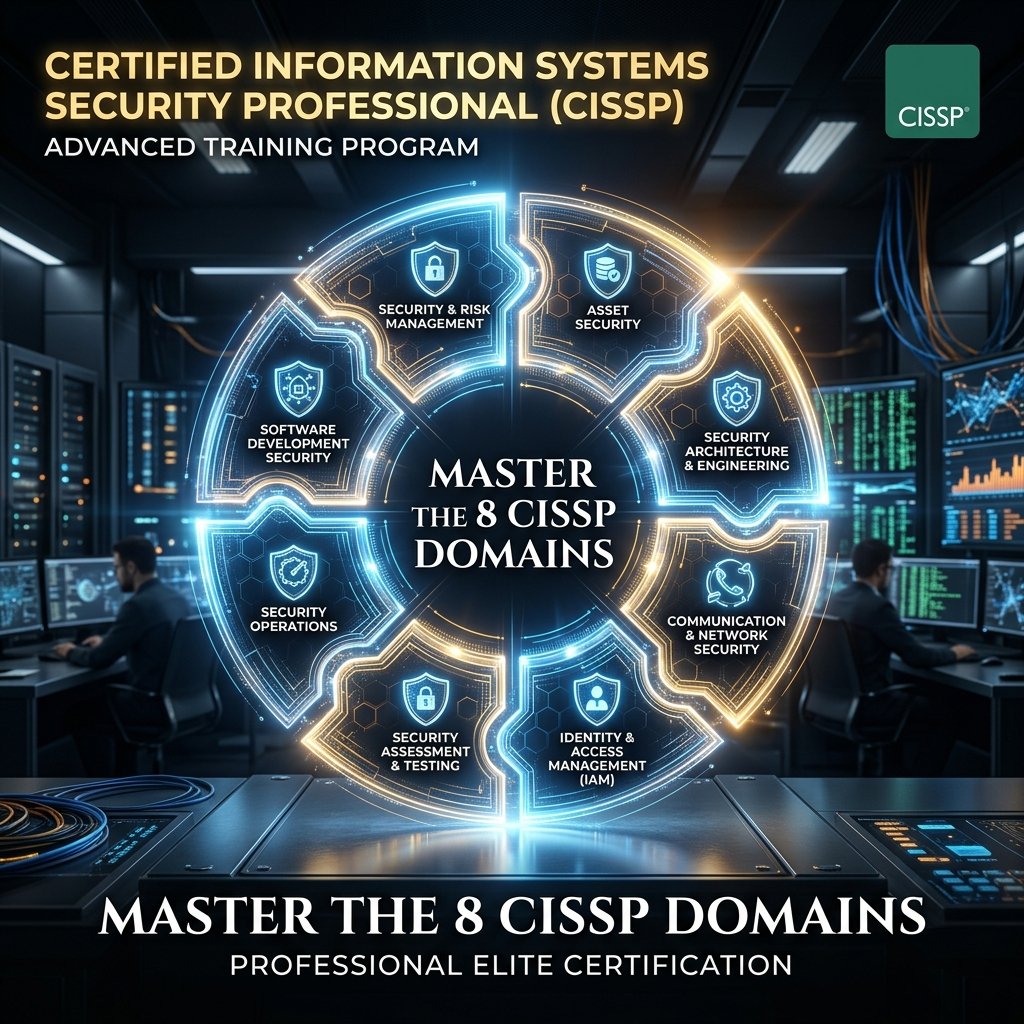
• Cover all eight domains of the CISSP Common Body of Knowledge (CBK).
• Prepare participants to design, implement, and manage a robust cybersecurity framework.
• Equip candidates with practical skills to address real-world security challenges.
• Help participants achieve the CISSP certification by (ISC)².
Course Outline with Exam Domain Percentages:
Domain 1: Security and Risk Management (15%)
• Security governance principles
• Risk management and professional ethics
• Business continuity and compliance with laws and regulations
Domain 2: Asset Security (10%)
• Information and asset classification
• Data lifecycle management
• Secure handling of assets
Domain 3: Security Architecture and Engineering (13%)
• Secure design principles
• Cryptographic methods
• Site and facility security
• Trusted computing models
Domain 4: Communication and Network Security (13%)
• Secure network architecture and design
• Communication protocols
• Endpoint security and converged networks
Domain 5: Identity and Access Management (IAM) (13%)
• Access control models and authentication mechanisms
• Identity management and lifecycle management
Domain 6: Security Assessment and Testing (12%)
• Vulnerability assessments and penetration testing
• Audits and control validation techniques
Domain 7: Security Operations (13%)
• Incident response and digital forensics
• Logging and monitoring
• Disaster recovery and operational security
Domain 8: Software Development Security (11%)
• Secure software development lifecycle
• Secure coding practices
• Application security testing
Participant Outcomes:
After completing the CISSP training course, participants will:
• Have a deep understanding of the eight CISSP domains and their practical applications.
• Be able to design and implement security policies, standards, and frameworks.
• Analyze and mitigate risks associated with various organizational assets.
• Apply advanced cryptographic techniques and secure communication protocols.
• Develop and maintain secure software applications and systems.
• Respond effectively to security incidents and implement robust disaster recovery plans.
• Be fully prepared to pass the CISSP certification exam and advance their careers in
cybersecurity.
Share your thoughts and help others choose the right course.
Secured via CyberSource & bKash
Global Authorization Protocols
Encrypted Transmission
Global Standards Validated